Concepts
Tense markers
- Time in sign language is not indicated through tenses, and the verbs in sign language do not change in form when tenses change.
- For example the sign for "eat" and "ate" are the same.
- Time is therefore indicated through the use of adverbs of time.
Intensity of signs
Intensity is shown by varying the speed, size, and force with which a sign is made, increasing the number of repetitions of a gesture, or by incorporating facial expressions. For example:
- Walk can be made quickly or slowly to indicate how the person is walking.
- Drink can be modified depending on the volume consumed.
- Smart becomes brilliant when the sign is exaggerated.
- Pretty becomes beautiful when the sign is exaggerated.
- What becomes WHAT by moving your index finger across your body instead of just across your palm.
- Need becomes must when the gesture is done with more force.
- Indicating how many times you have told a person something by repeating the gesture and then counting up the number of times it has been told.
Letter drag
You can drag out letters at the end of a finger spell only if the ending letters are the same. The motion is like pulling the letter out to the side.
You cannot do a letter drag for duplicate letters at the start or the middle of a word, only at the end.
Plural words
Plural words are denoted by repeating the sign once more.
Nouns from verbs
Usually, the noun form of a word is just the verb form done twice.
Classifiers (CL)
How is a classifier different from a hand shape?
Hand shapes are one of the 5 fundamental building blocks or parameters of a sign, which are:
- Hand shape
- Movement
- Location
- Orientation
- Non-manual markers
Those 5 parameters are the basic categories. You can divide "non-manual markers" or other parameters into several smaller categories, but there are still 5 main parameters. Non-manual markers include the aspects of body language that do not involve the hands, such as shoulder movements, head tilts, and facial expression.
Classifiers are designated hand shapes and rule-grounded body pantomime used to represent nouns and verbs. The purpose of the classifier is to provide additional information about nouns and verbs such as:
- Location
- Kind of action
- Size
- Shape
- Manner
Sign language has many classifier hand shapes to represent specific categories or class of objects.
The hand shape of a sign is literally the shape in which we form our hand during the production of a sign. All signs have a hand shape.
Classifiers are signs which use hand shapes that are associated with specific categories or classes of size, shape, or usage.
Uses
Classifiers can help to clarify your message, highlight specific details, and provide an efficient way of conveying information.
Classifiers can be used to:
- Describe the size and shape of an object.
- Represent the object itself.
- Demonstrate how the object moves.
- Convey how it relates to other objects and or people.
Basic rules
- To designate the referent of a classifier, a signer must either finger spell or sign the referent before the classifier can be used.
- To choose an appropriate classifier, there must be a relationship between the referent and the descriptive nature of that specific classifier.
List of classifiers
CL-1
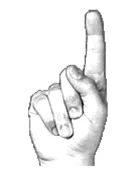
- Most commonly used to describe a singular person.
- Long skinny objects.
- Small cylindrical objects, such as sticks and pencils.
- Delineating 2-dimensional objects, like poster boards, a plot of land, circle, diamond, or any shape.
- Trajectory paths or connections, such as a one-way street, two-way street, intersection, ball flying midair, a snake moving across a surface, and tears.
- The way certain animals move, by changing CL-1 to CL-X, such as a caterpillar crawling, worm tunnelling, and snail crawling.
CL-3
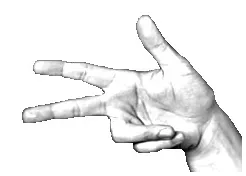
- Motorised vehicles, like a car, tractor, helicopter, bus and motorcycle.
- Vehicle related events, like parking a car, driving erratically, parallel parking, and types of car accidents.
- Vehicle locations, like:
- A car was here.
- There was a car in this location facing or moving in this direction.
- Groups of 3, like 3 people crossing the road.
- Feet, such as duck feet, hiking, walking, and the position of the feet as a person walks.
- Liquid spray over large surfaces, such as spray-painting a car or a house.
- When done upright, it refers to the sails on a boat.
CL-3 (claw/bent/curved)
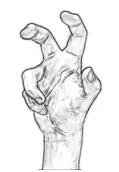
- Small objects gripped by the index, thumb and middle finger, like a computer mouse, baseball, or bowling ball.
- Large beak, which is commonly used to represent birds of prey, like eagles and falcons if it is placed in front of your mouth.
- Hands (this is a modified version of the CL-5 claw), particularly for scaling or climbing a large object, like a wall or boulder.
- Hands that are stashing, such as stocking shelves, investing in stocks, etc.
- Containers that are held by the index and thumb, and require the use of the thumb to eject their contents, like a syringe for vaccinations.
CL-4
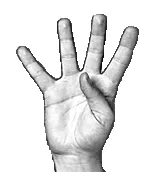
- Parallel lines, such as stripes, bars, fence, and upright boundaries.
- People standing in line, as well as the movement of lines of people.
- Objects that flow or leak, like blood, drool, running water, or draining sinks, pipes or ears.
- Objects that stream or extend, like curtains, hair, streamers and rainbows.
- Group of 4, such as 4 people standing or walking together.
- Traffic (which can also be represented by CL-5), like certain types of traffic movement, and multi-lane highways.
- Bandwidth, like streaming video or audio.
CL-5
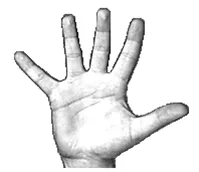
- Stiff and straight objects, like hair or fur that stand on end, such as a Mohawk.
- Objects that are extremely porous, such as filters and screens.
- The movement of air, like wind and breezes.
- Group of 5, such as 5 people standing or walking together.
- Large flat object like a serving platter or a flat lid.
- Flowing porous objects (by using a modified CL-5), and transitioning either from CL-O to CL-5, or vice versa. Such objects include headlights, flashing lights, sunlight and a shower.
- Objects that have projectile movements such as vomit, diarrhoea, flash flood, and a lot of tears.
- Delineate height or the movement of water, like an ocean, a flood, rising water, waterfalls, and rivers.
- Traffic (by using a modified CL-4 or CL-5), like traffic jams and multi-lane highways.
- Upright objects which are viewed while travelling at high speeds. This classifier is commonly used to describe blurred scenery while driving at high speeds.
- The movement of a fan or blowing air.
- Batting of eyelashes, which is related to the sign for "flirt".
- The position or movement of a leaf.
- Flames.
CL-5 (claw)
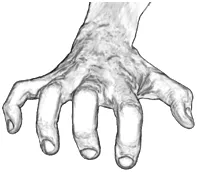
- Scads of items that are too numerous to count, such as stars in the sky, freckles, audiences or crowds.
- Large piles, as it is used to show curved top of large piles.
- Objects that are rough or jagged, such as rakes, an animal growling, or an animal biting.
- Objects that are withered or curled up, like withered plants.
- Curly hair or wavy hair
- The process of freezing or the state of being frozen.
- Representing groups of people sitting together, like carpools, a group of people packing into a car and people in a raft.
- Clouds, smoke, and airborne dust.
- Balls, like holding a ball or throwing a ball.
- Hands (which uses a modification of the CL-5 claw), particularly for scaling or climbing a large object like a wall or boulder.
- Gnarled, like to freeze, wither up, or knobby tires.
CL-A (open)
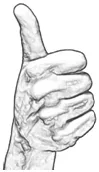
- An object in a specified location, like a house on a street, a statue or vase on a table, or a lamp on a desk.
- Positioning in relation to other people or objects, such as being ahead, behind, falling behind, chasing, catching up, accompanying, spaced apart, above, beneath, and facing each other.
- An object or person that commutes, like a person going to the bathroom repeatedly, a person going to work repeatedly, a ski-lift, or a ferry.
CL-B (flat)
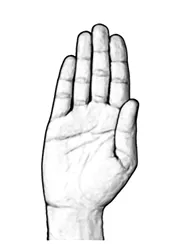
- Smooth, flat surfaces, like a road or runway, a wall, hallway, ceiling, floor, or a shelf.
- Flat mobile surfaces, like a surfboard, skateboard, snowboard, or a moving walkway.
- Inanimate objects in specified locations, like pictures on a wall, books on a table, racecar on a road, etc.
- Inanimate objects in specified positions, such as books lined upright on a shelf, papers facing down
- Height and width, like a person's height (refer to CL-B bent), the width of a box, or a stack of books.
- Delineating 3-dimensional objects, like a house or a box.
- A non-motorised riding device, like a horse or bicycle.
- It can be combined with CL-1, CL-3, or CL-ILY to show movement over surfaces.
- A sea turtle, by using both hands and wiggling your thumbs.
CL-B (curved)
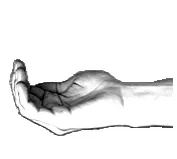
- Curved objects, like a bowl, sink, basin or a digging device.
CL-B (bent)
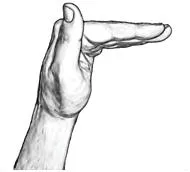
- Smooth, flat surfaces, like a long stretch of desert or road.
- Describing an object with sharp corners, like the top of an area, such as a shelf or refrigerator.
- A trailer, such as one that is pulled behind a truck.
- Amounts, like less of something.
CL-C
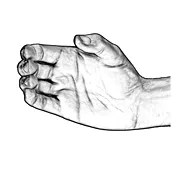
- Long cylindrical objects like a pipe, cave, tunnel, pole, small tree trunk, large branch.
- Short cylindrical objects, like a cup or glass, or a bottle.
- Thick objects, or the thickness or depth of an object, like a book, pizza, blanket, stack of papers, biceps, and snow fall.
CL-C (claw)
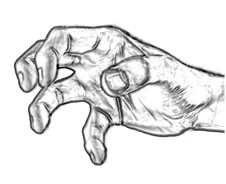
- Clusters of objects in specified location, like a group of students in the back room, or a bouquet of flowers.
- Sections, like the location of a room in a house, sections of a city, an article or column in a newspaper.
- Large objects in a specified location, like a house out in the middle of nowhere, or a camper on the back of truck.
- Medium, round, and squat objects, like a cookie, badge, small cap (yarmulke), a large dial, and over-ear headphones.
- Small spherical objects (by having your fingers closer together), like a clown nose, bulging eyes.
- Large spherical objects (by using two hands), like a ball.
- Teeth, like baring teeth, or showing a full set of teeth.
CL-C (index and thumb)
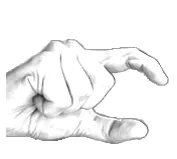
- Small, round and flat objects, like a disc, a piece of food, the moon in the sky.
- Height or width of small objects (similar to CL-G), like a small bottle of perfume, a short pencil, or a long screw or nail.
- Pincers or curved beaks.
- It is used to show the holding of small objects between the thumb and index finger.
CL-F
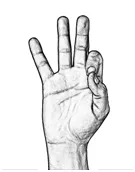
- The use, movement, or placement of small, thin, and round objects, like a button, coin, polka dots, pepperoni, pepper shaker, chain links, earrings and nose rings, a single drop of rain, or a single snowflake.
- Long, thin, and cylindrical-shaped objects, like a stick, dowel, curtain rod, a roll of toilet paper, water hose, or tap.
- Eye gaze, such as a person looking up or down, eyes moving back and forth, a person rolling his eyes, etc.
- Person moving along, like hiking, walking, or wandering around.
- Small round holes or openings.
- The manipulation or the holding of very thin things or small things, like flossing, threading a needle, turning a page, pulling out a hair.
CL-G
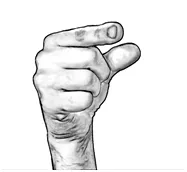
- Specifies small sizes, shapes, or amounts.
- The holding and manipulation or state of something relatively small, like earpieces, thumb drives, and eye-droppers.
- Lowercase, which is shown by starting with the fingers "expanded" and then change to the regular sized "G".
- Uppercase, which is shown by starting with your fingers closed and then change it to a wide-G or CL-C (index and thumb).
- Short or shallow depths, like a thin layer of ice, shallow water, a small stack of papers.
- Flat and thin (or shallow) object with squared edges, like a picture frame, ruler, strip of paper, or rails on a railroad.
- Thin shapes, like a moustache, sideburns, or collar.
- Small pinchers, like the beak of a small bird and tweezers.
- The movement of eyelids, like blinking, waking up, surprise, opening one eye, and squinting.
- Diminishing into the distance, or leaving, which is shown by changing from a wide-G to a closed-G to show concept of "gone".
- An object suddenly coming into view. An object that was far away comes closer (hence appearing larger) is shown by using a closed-G and expanding it into an CL-C (index and thumb).
CL-U
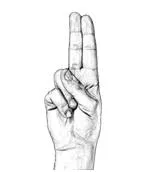
- Thin flat objects, such as knives, bacon, some types of noodles, name tags or badges, labels, bandage strips.
- Spreading butter, frosting, or similar substances.
- Boards like railroad ties and wooden or construction beams.
- A person standing with their legs together, which is a variation of CL-V.
- "Standing ovation", which is a person standing a surfboard.
CL-H
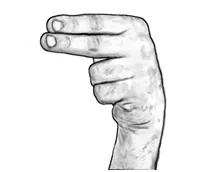
This classifier can include versions of the "H" hand in which the thumb is slightly separated from the fingers and then closes onto them as if showing a clamping, clasping or attaching movement.
- Fastening small objects to something else using a clasping movement, like badges, clip-on earrings, hair barrettes, and paper clips.
- The placement of an electrode onto the skin.
- A tongue, which is used by some variations of tongue movements.
CL-I
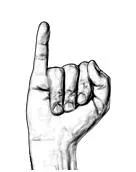
- Very thin and long objects, like a string, yard, wire, thread, cherry stem, thin-stringy noodles.
- Boundary lines and perimeters.
- Small or very small paint brushes.
CL-Horns (horns hand shape)
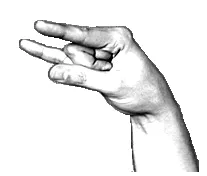
- Animals with two horns, like a bull, ox, or cow.
- Pronged items, such as goal posts, pitchfork, forklift, and the start gun at the beginning of a race.
- Objects with sharp borders for roofs and with loose or open sides, like a tent, canopy, circus, castle, carport.
- Two long, skinny objects spaced apart from each other, such as splits in bowling.
CL-ILY (ILY hand shape)
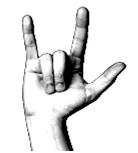
- Types of aeroplanes, and with slight finger modifications, an aeroplane can become a supersonic jet by combining CL-R with CL-Y, or a spaceship by combining CL-X with CL-Y.
- Movement of a plane, like landing, take off, skidding on a runway, and crashing in midair.
CL-L
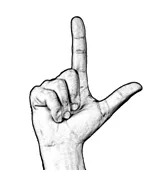
- Thin squared objects, like a place mat, a driving licence, or a greeting card.
- Thin squared objects in a specified location and or position, like pictures on a wall, mirror, or a window frame.
- Objects with a short barrel, like a drill, welding device, gun (pistol), and a laser.
CL-L (curved)
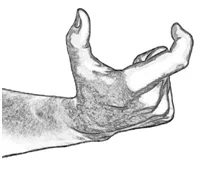
- Circular or oval-shaped objects, (similar to CL-C (index and thumb) but larger), like a dish, rug, or a platter.
- Thin and round surfaces, like a lake, round table, paint spill, round mirror, or a puddle of water.
- Spraying device, by moving the index finger, like a window cleaner or a water gun.
CL-O
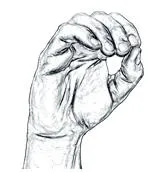
- Thick, medium-sized, cylindrical objects, like a rod, tree branch, pipe, large cable, fire hose, and salt shaker.
- Viewing devices like goggles, telescope and binoculars.
CL-O (flat)
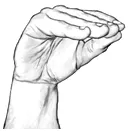
- The state of being flat.
- Having drank a bottle empty, or having read a book.
- Small, squat objects with rounded ends, like a Formula 1 car.
- Objects that are round at the bottom and have a slight opening at the top, like tulips and closed flower buds.
- Animals with long necks, like a giraffe, llama, goose, swan, dinosaur or cobra.
- Thick claws, by transitioning from CL-O (flat) to CL-5, like a lobster or pinchers.
- Shutting up (not talking).
CL-R
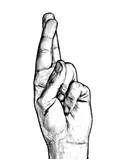
- Braided or twisted material, like a rope, cable, braids, and curled strands or hair or ribbon.
- Short, round, and somewhat thick object with narrowed tips, like cigars.
CL-S
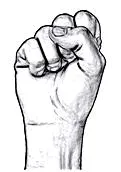
- Solid, spherical objects, like the head of a person or animal, or a head bobbing or a head retreating into a shell.
- Ramming devices, like the pistons of a car engine, fists, or anything solid that can be jammed in or packed in tight.
- Cranking handles, like a window crank, or an old fashion ice cream machine.
- Long thin round hand-held objects, like a spear, large stirring spoon, or a rake handle.
CL-V (CL-2)
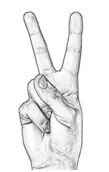
- People, more specifically the legs of people, laying down, standing up, legs together, and kicking.
- Two long things that are parallel to one another, like train tracks.
- Two-pronged devices, like forks and forklifts.
- Groups of 2, like 2 people walking together or standing.
- Scissoring object, like scissors or the claws of a crab or lobster.
CL-V (bent)
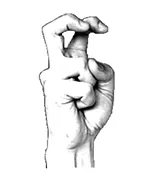
- Seated person or animal, like crouching, squatting, hunched down, perched.
- Bending knees, like climbing stairs or mountains, jumping, sitting, and the 2-handed version of galloping.
- Arrangement of chairs, like chairs in a semicircle or circle, or in multiple rows.
- Thin pulling object, like a bow string, or a pulling wire to signal the bus to stop or to flush an old-fashioned toilet.
- Sliding device like a sled or roller skates.
- Raking device that causes parallel scratch marks or paint streaks.
- Sets of teeth, like chattering teeth.
- Head of an animal with floppy ears, like a rabbit.
- Two pronged teeth, which is most commonly snakes, vampires, squirrels or chipmunks.
- Long objects with a connective ending like bones and joints.
CL-X
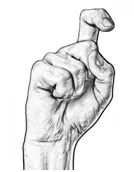
- A person or animal that is crouched or hunched over, which is a modified version of CL-1, like a person who skulks, slinks, shrinks or slouches.
- A scratching or digging device causing a scratch or scar, or a digging or chipping apparatus, such a pickaxe or mining tool.
- Anything with a hook, like a boat anchor, door latch, fishing hook, talons, tow, bat (animal), beaked nose, scorpion's tail, and clothes hangers.
- Long curved sliding device, like ice skates and skis.
- The movement of bent legs, like running furiously, cross-legged, kicked-back (relax), a bull pawing at the ground before charging, etc.
- The movement of a convertible car's top.
CL-X (cocked)
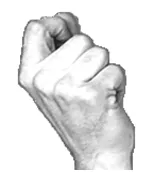
- A plant ready to sprout.
- Small bulbous objects like an onion or garlic.
- A snake or frog tongue just before flicking outward from the mouth.
- A piece of popcorn prior to popping.
- It is the starting hand shape used in spitting or spewing of small amounts of liquid.
CL-Y
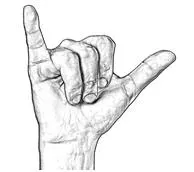
- Wide or long objects, like hippopotamus' mouth, long word, and high heels or stilettos.
- Objects with handles, like a beer mug, pitcher, and in some instances, suitcase, luggage, or briefcase.
- Long curved object, like a cow horn, smoking pipe, or a telephone.
- Spanning the width or breadth of an object, like a ruler.
- Certain types of precision knives, like using a straight-edged razor.